

 DailyPay Platform
 Small Business

 Off-Cycle Pay
 Tips
 Perks




How to reduce the employee turnover rate at your company
Updated Oct 26, 2026 · 10 min read
- What is employee turnover?
- Types of employee turnover
- Regrettable vs. non-regrettable turnover
- Turnover vs. attrition
- How to calculate your turnover rate
- What is a good turnover rate?
- Causes of high turnover
- The impact of high turnover
- How to reduce employee turnover
- Companies that reduced turnover
- FAQ
What is employee turnover?
Employee turnover refers to employees leaving an organization and being replaced by new employees. It’s a measure of the rate at which employees join and leave a company over a specific period.
Employee turnover in 2026: the latest data
Turnover has cooled from its Great Resignation peak but remains a costly, ongoing challenge. According to the U.S. Bureau of Labor Statistics, the quits rate was 1.9% in August 2026.1 Millions of workers still voluntarily leave their jobs every month.
The cost is substantial. SHRM estimates that replacing a single employee costs between 50% and 200% of that employee’s annual salary,2 costing U.S. businesses significant expenses every year. On top of direct replacement costs, a vacant role loses productivity, and new hires typically take months to reach full productivity.
Turnover also varies widely by industry, which is why context matters when you benchmark your own rate.
As of August 2026, the annual turnover rate hovers around 1.0% in finance and insurance an=d roughly 0.9% in real estate and rental leasing, but climbs to about 3.0% in retail turnover rates and can exceed 3.5% in hospitality.3
Knowing your industry’s baseline tells you whether your rate is a red flag or simply normal for your sector.
What are the types of employee turnover?
Employee turnover can be classified into two types: voluntary turnover and involuntary turnover.
Voluntary Turnover
This occurs when employees choose to leave the organization willingly. Reasons for voluntary turnover can vary and may include pursuing better job opportunities, seeking career advancement, dissatisfaction with the current job or work environment, relocation, retirement or personal reasons.
Involuntary Turnover
Involuntary turnover refers to employees being separated from the organization against their will. This can happen due to various reasons, such as poor performance, violations of company policies, downsizing, restructuring or disciplinary actions.
Regrettable vs. non-regrettable turnover
Beyond the voluntary/involuntary split, the most useful distinction for prioritizing your retention effort is whether a departure is regrettable or non-regrettable. Not all turnover is bad, and treating it all equally wastes resources.\
Regrettable turnover: the loss of employees you wanted to keep — strong performers and hard-to-replace skills. This is the turnover worth investing in to prevent.
Non-regrettable turnover: the departure of employees whose exit has little or even positive impact, for example poor performers or roles being phased out.
It’s also worth tracking first-year turnover (people who leave within 12 months often signal a hiring or onboarding problem) and high-performer turnover separately. When you segment turnover this way, you can focus energy on the losses that actually hurt the business.
Employee turnover vs. employee attrition
Employee turnover should not be confused with employee attrition, a term which specifically refers to the natural or gradual reduction in the size of the workforce due to employees leaving the organization without being replaced.
Attrition typically occurs through voluntary means, such as retirements, resignations or employees choosing not to renew their contracts. Attrition is often seen as a more passive form of employee turnover, where the organization doesn’t actively initiate the departure.
How to calculate your employee turnover rate
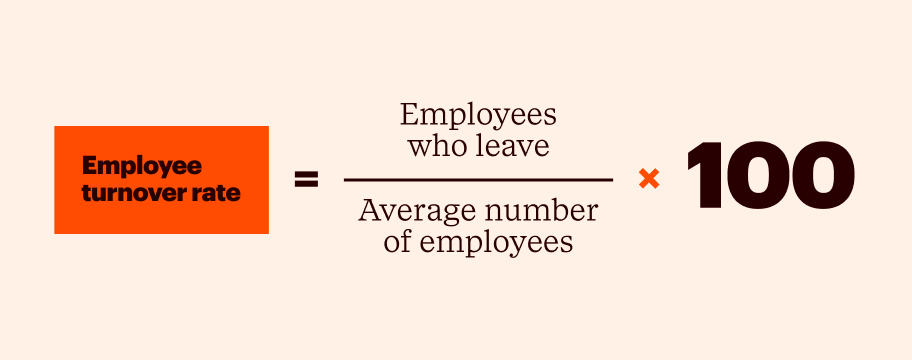
To calculate your employee turnover rate, divide the total number of employees who leave your organization in a month by the average number of employees at your company. Multiply this number by 100 to determine your employee turnover rate percentage.
Use our interactive employee turnover calculator to calculate your retention improvement and potential cost savings.
What is a good employee turnover rate?
Once you can calculate your rate, the natural next question is whether it’s good or bad, and the honest answer is that it depends on your industry, roles, and the type of turnover involved.
As a general rule, an overall annual turnover rate around 0.9% or below is often considered healthy, but this varies dramatically by sector.
Rather than chasing a universal number, compare your rate against your industry benchmark, track it over time, and separate regrettable from non-regrettable turnover. A 1.6% rate made up almost entirely of non-regrettable departures is far healthier than a 0.9% rate that’s losing your best people.
The goal isn’t zero turnover; some churn is natural and even healthy. It’s minimizing the departures you can’t afford.
Causes of a high employee turnover rate
After you’ve calculated your employee turnover rate, it’s important to understand why employees leave. Here are some of the most common causes.
Financial Stressors
According to the 2022 PWC Employee Financial Wellness Survey, financially stressed employees are twice as likely to be looking for a new job.4
Poor Work-Life Balance
A poor work-life balance is not only potentially harmful to employee morale and well-being but also a significant driver of high employee turnover rates. Inflexibility in the workplace is a significant issue, and one growing even faster in a work environment with young people.
Insufficient Career Advancement Opportunities
A lack of potential for career growth and professional development can hurt your company’s turnover rate. If your company doesn’t offer growth potential, you should consider how to upskill and train high-potential employees, minimizing the chances of turnover.
Poor management
According to Work Institute’s 2026 Retention Report, 74.7% of all exits are preventable. Most employees leave due to internal issues leadership can fix.5 If your turnover is concentrated on particular teams, look at the management of those teams before anything else. It’s often the single most revealing and most fixable cause of high turnover.
The negative impact of high employee turnover
A high employee turnover rate can be detrimental to a company’s overall success. Some negative effects of a high employee turnover rate can harm your workplace culture, inhibit your company’s ability to provide outstanding customer service, and rack up a multitude of costs:
- Departure costs: direct administrative, processing, and severance fees.
- Lost production: vacant positions that lower operational output (learn how to boost workplace productivity).
- Recruiting costs: expenses related to job postings, applicant tracking, candidate screening, and interviewing.
- Onboarding and training costs: the time and resource investment required to bring new hires up to full performance capability.
How to reduce the employee turnover rate at your company
As explained above, a high employee turnover rate can bring about some negative effects on your company if left unaddressed. Productivity loss, reduced employee morale, and increased hiring and training costs are just a few of the most common adverse effects. To avoid these issues, companies should consider how they can reduce their employee turnover rate by increasing employee happiness.
Hire the right people from the start
The cheapest way to reduce turnover is to avoid mis-hires in the first place. A large share of turnover, especially first-year turnover, traces back to a poor fit between the person, the role, and the culture. Tightening your hiring process pays retention dividends for years.
Write honest job descriptions that reflect the real work, screen for alignment with your values and not just skills, give candidates a realistic preview of the role, and involve the team they’ll join. Every mismatch you catch before an offer is a costly departure you never have to manage.
Develop better managers
Because managers are the biggest driver of whether people stay, developing them is the highest-leverage retention investment available. Yet many managers are promoted for individual performance and never taught how to lead a team.
Train managers to hold regular, meaningful one-on-ones, set clear expectations, recognize good work, and coach rather than simply supervise. Give them the tools to spot disengagement early and the time to act on it. Then hold them accountable for retention on their teams, because a great manager is the most durable retention tool a company has.
Strengthen onboarding and the first 90 days
Onboarding is one of the best defenses against turnover. An employee’s decision to stay or go is often shaped within their first 90 days, and a large portion of early turnover is set in motion by a weak start.
Great onboarding sets clear expectations from day one, pairs new hires with a buddy or mentor, provides the tools and training to succeed quickly, and connects each role to the company’s bigger purpose. Extend it well beyond the first week with structured check-ins through the first three to six months so early enthusiasm turns into lasting commitment.
Conduct stay interviews and act on feedback
Most companies only learn why employees leave at the exit interview, when it’s too late. Stay interviews flip that: you ask your current employees, especially your best ones, what keeps them here and what might tempt them to leave, while you can still do something about it.
Pair stay interviews with continuous listening — pulse surveys, one-on-ones, and honest exit interviews — to spot patterns early. The critical step is acting on what you hear and telling employees what changed. Feedback that visibly leads to action builds the trust that keeps people from looking elsewhere.
Offer flexibility and support work-life balance
Inflexibility is one of the fastest-growing drivers of turnover, particularly among younger workers, so flexibility is one of the fastest-growing retention levers. Where the work allows, offer remote or hybrid options, flexible hours, and a culture that respects time off and protects against burnout.
Flexibility extends to pay, too. Giving employees more control over when they can access wages they’ve already earned through earned wage access (fee may apply) is a low-cost, high-impact way to ease the financial stress behind so many resignations.
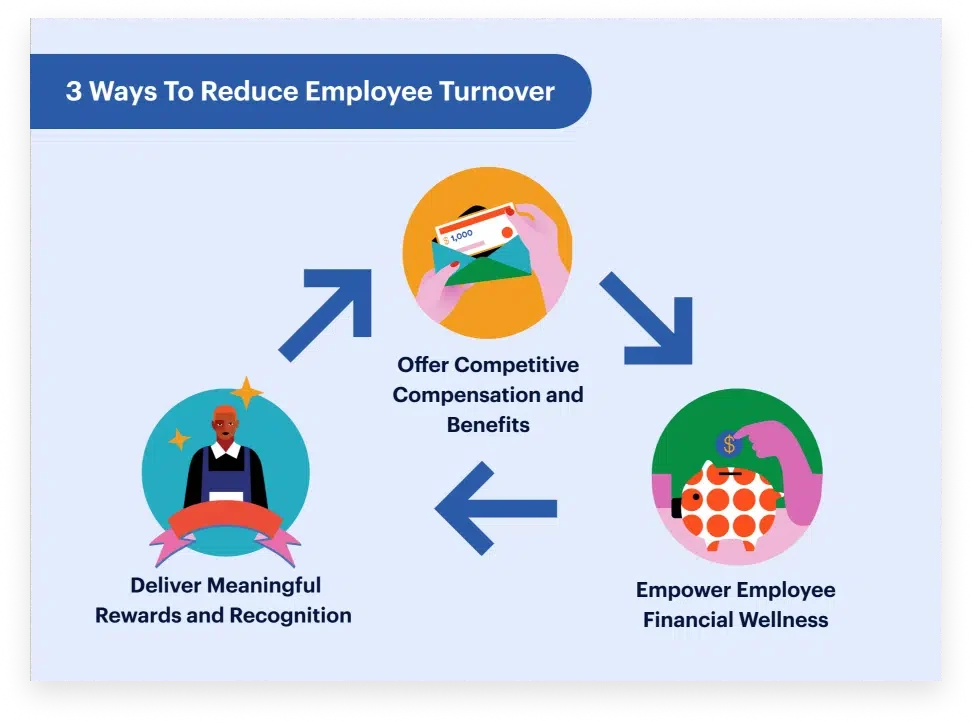
Offer competitive compensation and benefits
A comprehensive benefits package that goes above and beyond competitors will give a hiring edge and contribute to employee appreciation and retention.
Competitive compensation means not only paying industry-standard wages, but also giving employees more flexibility to access their earned wages before payday. Compensation involves not only how much an employee gets paid, but also how often. Employees dealing with financial stress will see negative effects on performance and productivity.
Support employee financial wellness
Employers should consider how they can further support employees through financial wellness programs. These benefits may help employees keep track of earnings and expenses, pay bills on time, budget for the future, and more. For step-by-step guidance, explore our resources for improving employee turnover.
Deliver meaningful rewards and recognition
Recognizing an employee for their hard work can play an important role in motivating and retaining employees. However, this reward should be meaningful and provide a tangible incentive for employees who’ve gone above and beyond in their roles.
Identify flight-risk employees with people analytics
You don’t have to wait for a resignation letter to see turnover coming. Modern people analytics let you spot warning signs like declining engagement scores, dropping participation, tenure milestones, or shifts in behavior well before a valued employee is out the door.
Start simple. Track voluntary turnover by team, manager, tenure, and performance tier to see where regrettable losses cluster. Combine engagement data with these signals to flag at-risk individuals and give managers a prompt to have a retention conversation while it still matters. The goal is to catch solvable problems early.
These companies have reduced employee turnover rates with On-Demand Pay
Why top companies trust DailyPay
Learn how an added benefit such as on-demand pay may increase employee retention for organizations.
DialAmerica experienced 58% less turnover in the first two weeks on the job among agents who are using DailyPay compared to those who are not using DailyPay.
Calhoun Management employees who use DailyPay stay nearly twice as long as those who don’t!
Adecco used DailyPay to increase retention, with turnover currently at 36% for non-DailyPay users and 22% for DailyPay users
Discover how on-demand pay reduces turnover to help bolster your overall employee retention strategy.
Frequently Asked Questions
-
What are the two types of employee turnover?
Typically, employee turnover can be broken down into two major categories: voluntary and involuntary.
-
What is an employee turnover rate and how is it calculated?
To calculate your employee turnover rate, divide the total number of employees who leave your organization in a month (or a year) by the average number of employees at your company. Multiply this number by 100 to determine your employee turnover rate percentage over that time period.
-
What is a good employee turnover rate?
While it can vary based on industry and economic conditions, a general rule of thumb is that 10% is the average turnover rate.
-
Why is it important to reduce your employee turnover rate?
Reducing your employee turnover rate can result in greater productivity, happier employees and cost savings.
-
How do you reduce your employee turnover rate?
To reduce your employee turnover rate, your company should focus on supporting employees through competitive benefits and pay, a good work-life balance and room for career growth.
-
Which industry has the highest employee turnover rate?
In 2022, leisure and hospitality had the highest turnover rate (annual average job openings) across all industries, according to the BLS.2
-
How does high turnover hurt productivity?
With higher turnover, employees may feel less motivated and engaged in their roles.
-
Does burnout lead to high turnover?
Yes, if an employee feels burned out in their role, they’re more likely to seek a new job opportunity with increased work-life balance.
-
Can flexible pay benefits reduce turnover rates?
Flexible pay can reduce a turnover rate and make employees more likely to stay with their current employer. According to a November 2022 DailyPay User Survey, 48% of users say they are more motivated to remain with their current employer because they offer DailyPay.
1. 3. 6. 8 BLS, Table 4. Quits levels and rates by industry and region, seasonally adjusted, Aug 2026:DailyPay, 2020
2, 7 SHRM, The Myth of Replaceability: Preparing for the Loss of Key Employees, January 2025:DailyPay, 2020
4 Employee Financial Wellness, A Valoir Report, February 2026:DailyPay, 2020
5, 9 Work Institute, 2026 Retention Report - Stability Does Not Equal Commitment:DailyPay, 2020
All information herein is for educational purposes only and should not be relied upon for any other use. The information herein does not constitute the rendering of professional advice by DailyPay. No fiduciary obligation or duty exists, or is created, between you and DailyPay. DailyPay does not warrant the completeness or accuracy of any information provided to you.
Why top companies choose DailyPay
More control for employees
Access to earned wages when they need it, giving employees greater control over their pay.
Financial wellness tools that help employees plan, manage and make more informed decisions about their money.
An easy-to-use experience that puts pay and financial tools in one place.
Simple and secure for employers
Integrates with existing payroll and HCM systems with minimal disruption.
Built to work seamlessly across payroll, banking and benefits ecosystems.
Enterprise-grade security and reliability designed to protect data and keep DailyPay available when employees need it.