

 DailyPay Platform
 Small Business

 Off-Cycle Pay
 Tips
 Perks





Reduce turnover with an employee retention strategy
Updated Nov 3, 2026 · 10 min read
A strong employee retention strategy protects the knowledge, customer relationships, and momentum your business has already built. When you understand what drives people out, you can build a plan that improves retention, morale, and revenue.
Employee retention is the percentage of employees who remain with an organization year over year. The percentage who leave determines your turnover rate.
On this page, we cover the elements of an employee retention strategy, why retention matters to your business, and how a total rewards package that includes On-Demand Pay supports it.
An employee retention strategy aims to increase year-over-year retention by giving employees reasons to stay and grow. Methods include:
- Increasing employee incentives
- Improving financial security
- Defining clear career paths and growth opportunities
Companies with an effective retention strategy protect culture, revenue, and customer service. Companies without one absorb the cost of turnover instead.
Why do employees leave?
Retention starts with understanding why people go. Exit interviews surface the same reasons again and again:
- Pay that has fallen behind the market
- A benefits package that lags competitors on health, retirement, and financial wellbeing
- Burnout and a lack of day-to-day support
- Limited advancement, learning, or development opportunities
- Managers who do not recognize good work
- Too little flexibility or work-life balance
- Financial stress, which pulls attention away from work and toward the next pay cycle
Money is rarely the only factor, but it’s almost always a factor. The strategies that work address both the emotional drivers, such as respect, growth, and recognition, and the practical ones, including pay, benefits, and financial security. Benefits like on-demand pay (also known as earned wage access) address that last category directly.
Industries with the highest employee turnover
Turnover is not distributed evenly. Service and frontline sectors consistently report the highest separation rates, including healthcare, hospitality, and retail.1
These are the same industries where schedules shift week to week and where a single unexpected expense can change an employee’s plans.
Each sector carries its own retention pressure points:
- Healthcare. Physically demanding shift work, frequent overtime, and pay that often trails the cost of living in the communities these workers serve.
- Hospitality. Seasonal and event-driven staffing swings, tip-dependent income, and a workforce that skews toward employees juggling multiple jobs or school schedules.
- Retail. Unpredictable scheduling, part-time hours that limit benefits eligibility, and heavy competition for the same local labor pool.
On-Demand Pay has been associated with improved retention in sectors where financial stress and irregular pay timing compound these pressures.
- 69% of DailyPay users who work in healthcare say they are more likely to stay at a job that has DailyPay.2
- 66% of DailyPay users who work in hospitality say they are more likely to stay at a job that has DailyPay.3
- 65% of DailyPay users who work in retail say they are more likely to stay at a job that has DailyPay.4
The costs of low employee retention
Turnover shows up in two places: your budget and your culture. It thins the company knowledge base, strains the people who stay, and interrupts customer relationships. The monetary costs include:
- Departure costs. Calculating final pay, administering severance and benefits, and recovering company equipment.
- Lost production. Gaps in project progress when experienced staff leave, plus the effect on sales and customer service when knowledgeable employees depart.
- Overtime. Remaining staff cover the gap, often at premium rates.
- Recruiting. Advertising, agency fees, candidate screening, interviews, background checks, and assessments.
- Onboarding and training. Processing new hire data, adding employees to payroll and benefits systems, and bringing them up to speed on the role, policy, and culture.
Calculate the turnover cost savings for your business with our interactive calculator, then see how to reduce employee turnover step by step.
How many employees do you have?
What is your annual turnover rate?
Cost per new hire
fewer replacement hires
0
employer cost savings
0

Disclaimer: Calculations based on assumptions and annualized averages
15 employee retention strategies
The most effective retention programs combine everyday improvements with longer-term investments in people. Here are 15 strategies to start with.
1. Pay fairly and often
Review salaries against the market on a regular schedule, not just at annual review time. How employees access their pay matters too. On-Demand Pay gives employees access to wages they have already earned before payday,5 which eases the financial pressure that pushes people to look elsewhere.
2. Offer benefits employees actually want
Go beyond standard health coverage with financial wellness, mental health support, and flexible benefits. Survey your workforce to find out what matters most rather than guessing. The benefits people use are the benefits that keep them.
3. Invest in onboarding
A structured onboarding experience sets the tone for an employee’s entire tenure. Help new hires build relationships, understand the culture, and reach full productivity faster. The first 90 days shape whether someone sees a future with you.
4. Build clear career paths
People stay when they can see a future. Offer training, upskilling, and internal mobility so employees can grow without leaving. Make the path visible, and make the next step specific.
5. Train and support managers
Managers have an outsized effect on retention. Give them the communication, coaching, and recognition skills to build strong relationships with their teams. A manager who runs good one-on-ones prevents more turnover than most retention programs.
6. Recognize and reward good work
Regular, specific recognition costs little and signals a lot. Employees who feel valued stay longer, and recognition works whether it’s formal or a note in a team channel. For more tactics, see our employee engagement strategies.
7. Prioritize work-life balance and flexibility
Flexible schedules, remote options, and respect for time off reduce burnout and make roles easier to stay in. For frontline teams, predictable scheduling and input into shift assignments often matter more than remote work.
8. Communicate transparently
Open, frequent communication about strategy and change builds trust. It also removes the uncertainty that prompts people to start looking. Employees fill information gaps with worst-case assumptions.
9. Give employees autonomy
Avoid micromanaging. When people can make decisions about how they do their work, they take more ownership of the outcome. Autonomy costs nothing and compounds over time.
10. Support financial wellbeing
Financial stress follows people to work. Tools like on-demand pay, automated savings, and financial education help employees handle expenses that do not line up with the pay cycle. Learn more about our financial wellness platform.
11. Act on employee feedback
Use surveys, one-on-ones, and exit interviews to spot problems early, then make the changes. Listening without acting erodes trust faster than not asking at all. Close the loop publicly so employees can see what changed.
12. Publish schedules further in advance
Publishing schedules one to two weeks out gives employees room to plan childcare, transportation, and second jobs around their shifts.
13. Allow shift swaps
Give employees a straightforward way to trade shifts with a qualified coworker, with manager visibility but not manager gatekeeping on every swap.
14. Give tenure priority in scheduling
Reward employees who stay by giving them earlier access to preferred shifts, requested time off, and schedule changes. Tenure-based priority turns time served into a visible, ongoing benefit rather than a one-time raise.
15. Build a referral program
Current employees know which candidates will actually fit the role and the team. A referral program that pays out after the new hire reaches a retention milestone, not just after they start, rewards employees for bringing in people who stay.
Build a total rewards program
A total rewards program brings compensation, benefits, wellbeing, growth, and recognition together into one coordinated offer. It should include:
Compensation
Compensation covers how much employees earn and how they can access what they have earned. Financial stress affects performance and focus, so both parts matter.
Benefits
A benefits package that goes beyond what competitors offer gives you a hiring edge and a retention edge. It also signals what your company values.
Employee well-being
Employees want better work-life balance and lower stress levels. Personal and financial pressure shows up in focus, attendance, and output.
Employee growth and development
Strong financial habits and clear development paths set employees up for long-term stability. Both give people a reason to build a career with you rather than a stop along the way.
Rewards and recognition
Recognizing hard work plays a direct role in motivating and retaining employees. Consistency matters more than budget.
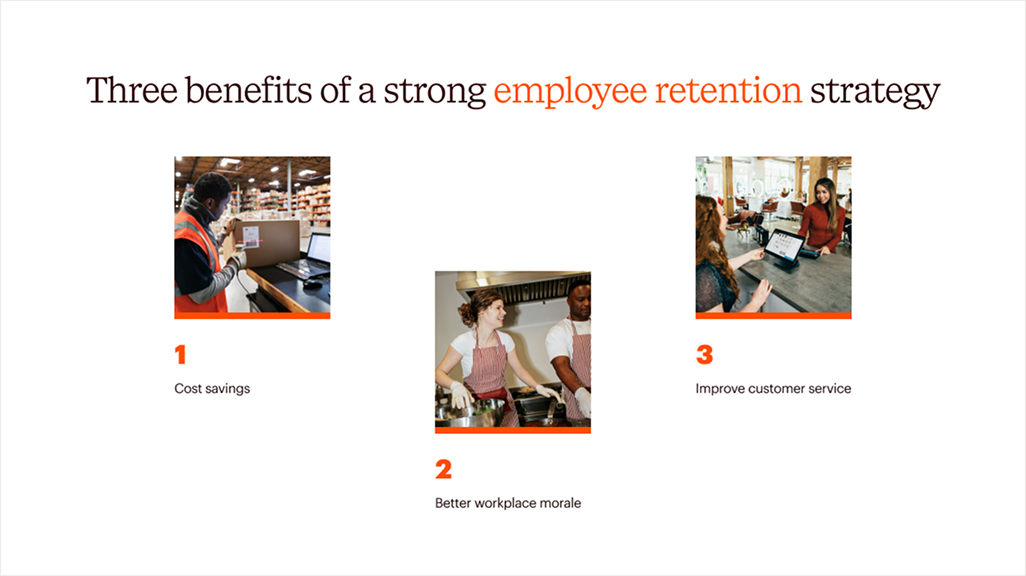
The benefits of high employee retention
Retention pays off in more than avoided turnover costs. It shows up in your bottom line, your team’s day-to-day experience, and the service your customers receive.
Cost savings
Retaining employees avoids the turnover costs listed above. Every role you keep filled is a recruiting cycle you do not pay for.
Better workplace morale
High turnover wears on the people who stay. Organizations with high engagement outperform their peers on profitability, productivity, customer satisfaction and retention.6
Improved customer service
Retained employees know your customers, your systems, and your standards. That continuity shows up in fewer process interruptions and stronger service.
To calculate your employee turnover rate, divide the total number of employees who leave your organization in a month by the average number of employees at your company. Multiply this number by 100 to determine your employee turnover rate percentage.
How to calculate your employee retention rate
Measuring retention is straightforward, and tracking it over time tells you whether your strategy is working. To calculate your employee retention rate for a given period:
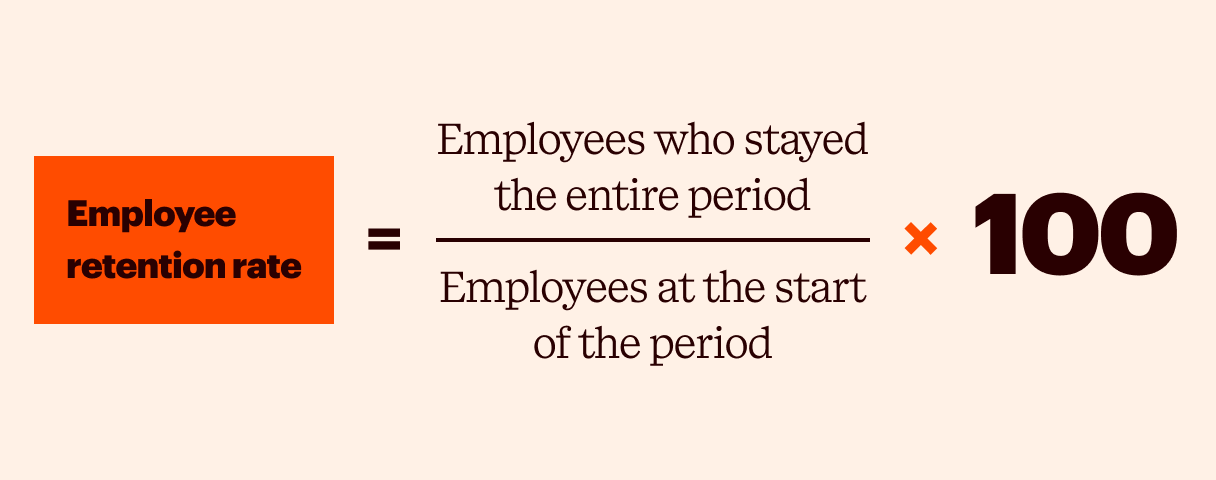
Exclude anyone hired during the period. You are measuring how many of the people you started with are still there at the end.
Example scenario
Suppose you had 200 employees on January 1. By December 31, 180 of those original employees were still with you. Your annual retention rate is (180 ÷ 200) × 100 = 90%.
Track retention alongside your turnover rate and employee satisfaction scores to get a complete picture of workforce health.
How often to measure, and how to segment it
A single annual number tells you whether you have a problem. Segmenting the calculation tells you where it is.
Measurement frequency. Calculate retention quarterly at minimum. Frontline and hourly roles turn over fast enough that a full year can hide a problem until it is expensive to fix. Monthly tracking works well for high-turnover departments, quarterly is usually sufficient elsewhere.
Segment by tenure. Run the calculation separately for employees in their first 90 days, their first year, and beyond one year. A 90-day retention rate that lags the rest of the business points to an onboarding problem, not a compensation problem, and the fix is different.
Segment by department, location, or shift. A healthy company-wide rate can mask a single struggling location or a night shift losing people faster than days. Break the number down by the manager where you can. Manager quality is one of the strongest predictors of team-level retention, and location-wide averages hide that signal.
Segment by voluntary versus involuntary departures. Combining resignations with terminations and layoffs makes the number harder to act on. Track voluntary turnover separately, since that is the figure your retention strategy is actually meant to move.
What a declining trend signals. A retention rate that drops two or more quarters in a row, even by a few points, is worth investigating before it shows up in your annual number. Pair the trend with exit interview themes and engagement survey scores from the same period. If the decline concentrates in one segment, tenure band, or location, that is where to focus first rather than rolling out a company-wide fix for a localized problem.
Companies trust DailyPay
Organizations across healthcare, restaurants, retail, and staffing work with DailyPay to strengthen their employee retention strategies, including BrightSpring Health Services, PMTD Restaurants, DialAmerica, and Leevers Foods.
Frequently Asked Questions
-
What are the two types of employee turnover?
Typically, employee turnover can be broken down into two major categories: voluntary and involuntary.
-
What is an employee turnover rate and how is it calculated?
An employee turnover rate is the percentage of employees who leave your organization over a set period. Calculate it by dividing the number of employees who leave in that period by the average number of employees, then multiplying by 100.
-
What is a good employee turnover rate?
Based on the BLS monthly rates, as of August 2026, real-estate and rental leasing sees the lowest quits rate in the private sector at 0.9%.6 A good turnover rate depends on your industry. Compare your rate to your industry benchmark and focus on reducing regrettable turnover rather than chasing zero.
-
Why is it important to reduce your employee turnover rate?
High turnover is costly and disruptive. It drives up recruiting, onboarding, and lost-productivity costs, weakens workplace culture, and can hurt customer service. Reducing it protects both your budget and your institutional knowledge.
-
How do you reduce your employee turnover rate?
Reduce turnover by hiring for fit, developing better managers, strengthening onboarding, offering competitive and flexible compensation, supporting financial wellness, recognizing good work, and acting on employee feedback through stay interviews.
-
What is the difference between regrettable and non-regrettable turnover?
Regrettable turnover is the departure of employees you wanted to keep, usually strong performers or hard-to-replace skills. Non-regrettable turnover is the exit of employees whose departure has little or even positive impact, such as poor performers. Focusing on regrettable turnover tells you where retention effort actually pays off.
-
What is the average cost of employee turnover?
SHRM estimates that replacing an employee costs between 50% and 200% of their annual salary, depending on the role’s seniority and specialization.7
-
What is a good employee turnover rate by industry?
Benchmarks vary widely: According to BLS, as of August 2026, the annual turnover rate hovers around 1.0% in finance and insurance and roughly 0.9% in real estate and rental leasing, but climbs to about 3.0% in retail and can exceed 3.5% in hospitality.8 Knowing your industry’s baseline tells you whether your rate is a red flag or simply normal for your sector.
-
How do managers affect employee turnover?
According to Work Institute’s 2026 Retention Report, 74.7% of all exits are preventable.<sup>9</sup> Most employees leave due to internal issues leadership can fix. If your turnover is concentrated on particular teams, look at the management of those teams before anything else. It’s often the single most revealing and most fixable cause of high turnover.
-
How do stay interviews reduce turnover?
Stay interviews ask current employees, especially your best ones, what keeps them and what might make them leave, while you can still act on the answers. Unlike exit interviews, they surface problems in time to fix them, and following through on the feedback builds the trust that keeps people from looking elsewhere.
-
Can on-demand pay help reduce employee turnover?
Financial stress is a common and preventable driver of turnover, and on-demand pay gives employees access to wages they’ve already earned before payday, without changing your payroll cycle. DailyPay reports that offering it can help increase retention and reduce turnover.
1 BLS, August 2026:DailyPay, 2020
2, 3, 4 DailyPay Employee Experience Research, Arizent study commissioned by DailyPay, January 2026:DailyPay, 2020
5 Fee may apply.:DailyPay, 2020
6 Gallup, 2026:DailyPay, 2020
All information herein is for educational purposes only and should not be relied upon for any other use. The information herein does not constitute the rendering of professional advice by DailyPay. No fiduciary obligation or duty exists, or is created, between you and DailyPay. DailyPay does not warrant the completeness or accuracy of any information provided to you.
Why top companies choose DailyPay
More control for employees
Access to earned wages when they need it, giving employees greater control over their pay.
Financial wellness tools that help employees plan, manage and make more informed decisions about their money.
An easy-to-use experience that puts pay and financial tools in one place.
Simple and secure for employers
Integrates with existing payroll and HCM systems with minimal disruption.
Built to work seamlessly across payroll, banking and benefits ecosystems.
Enterprise-grade security and reliability designed to protect data and keep DailyPay available when employees need it.